

When your card is about to expire, it's tempting to put renewal off until the last moment. That's the single most common, and most expensive, mistake. A late filing, a weak document package, or misunderstanding your category's requirements can cost you time, money, and your calm legal status in the country.
Since May 2025, Spain has operated under a new Reglamento de Extranjería, approved by Real Decreto 1155/2024. That means older checklists floating around online, including some of our own earlier material, are partly outdated. Here's everything rebuilt from scratch: 2026 rules, exact amounts, the filing platform, and what to do if you're denied.
Two scenarios: renew or modify your residency
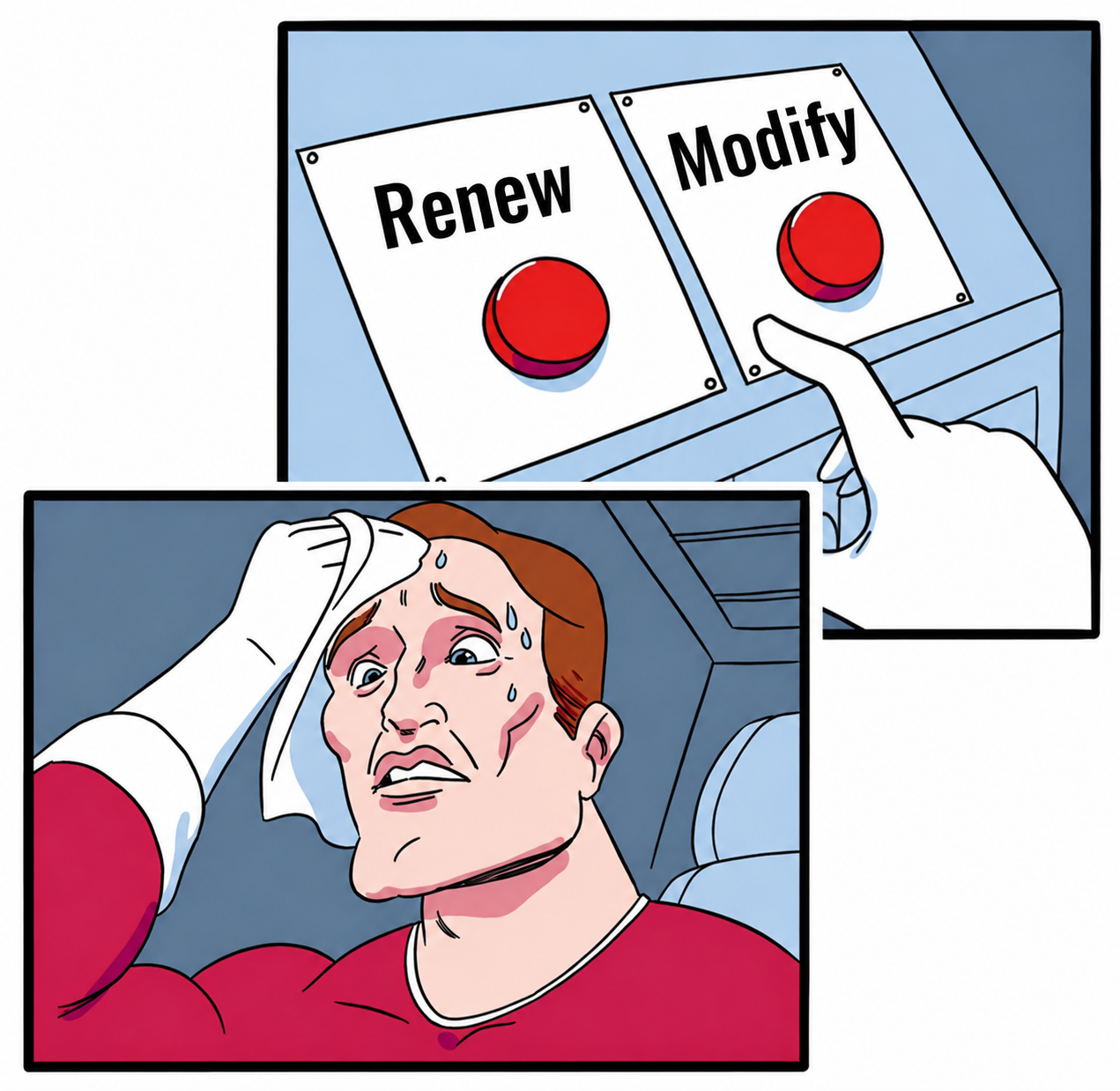
Scenario 1: renewing your current residency
This means updating your permit on the same grounds you're already living in Spain under: continuing your studies, running the same business, or holding the same property. The rule is simple: you show largely the same documents you provided for your first card, with one exception, a criminal record certificate usually isn't required again.
Example. You arrived on a student visa, successfully finished your current course, and plan to keep studying. This is a renewal, not a modification. Two things are needed: documented proof your previous studies were completed (a certificate or diploma), and proof you're moving up a level, for example starting a master's after a bachelor's, or advancing to a new level of Spanish.
💡 Tip: you can renew a student visa almost indefinitely, Spain places no cap on how many times. And as long as you remain a student, you're not required to pay tax. It's arguably the only residency type completely free of tax obligations.
Scenario 2: modifying to a new residency
This is a fundamentally different situation: you're not renewing your old status, you're obtaining an entirely new residency with different rights, documents, and timelines. Legally, the new card counts as a first-time permit.
Example. You arrived on a student visa, but found a job and decided to stay under a new status. Or you married a Spanish resident and are building your future in the country. Either way, this isn't a renewal, it's a modification, with its own document set and its own review logic.
👨👩👧 If you relocated as a family, you need to apply for modification together, all family members, including children, in one package.
What comes next on this path. An initial modification typically grants a card valid for up to 4 years. After that, with 5 years of legal residence in the country total, the path to permanent residency opens. Then, after 10 years of legal life in Spain, without leaving the EU for more than 10 months total, passing a culture exam, and Spanish at an A2 level, the path to a Spanish passport opens.
What the law says: short and clear
The base law on foreigners in Spain: Ley Orgánica 4/2000, de 11 de enero. But the practical renewal rules for 2026 need to be checked against Real Decreto 1155/2024, de 19 de noviembre, which approved the new Reglamento de Extranjería. The regulation entered into force on May 20, 2025 and applies to every application in 2026.
The core logic is simple: renewal isn't automatic, it's granted only if you continue to meet the conditions of your specific residency category. For one person that means income and insurance, for another it's employment status, for a third it's maintaining the family basis for residency.
It's important not to confuse two separate stages: first, the decision on renewing the residence authorisation itself (autorización de residencia), and only afterwards, issuing the new physical TIE card. These are two distinct procedures with different fees and different timelines.
The golden timing rule: minus 60, plus 90
Residency renewal follows a strict timing rule.
- 60 days before the TIE card expires: the optimal window to apply. You're still an active resident, your documents are fresh, and there's buffer time in case additional materials are requested
- Within 90 days after the card expires: formally allowed. Your resident status stays in limbo, you can legally remain in Spain while your application is under review, but the card itself is expired, and border crossings can get complicated
- After 90 days: critical zone. Filing is technically still possible, but only with a written explanation (alegaciones) justifying the delay. Extranjería can deny it outright. Missing the deadline by more than 90 days effectively means losing resident status
💡 Practical tip: set a reminder for 75 days before your card expires. That gives you a week's buffer to gather current documents and file without rushing.
How to file in 2026
The priority method: Mercurio, the official digital platform run by the Ministerio del Interior for online renewal filing. Your data goes straight to Extranjería with no paper queues.
Access requires a digital certificate (certificado digital) or the Cl@ve PIN system. You can get a certificate through FNMT online, followed by identity verification at Extranjería or your town hall, or through Cl@ve, a simplified system for foreigners who already hold a TIE.
Advantages of Mercurio: you can file from anywhere in the world without an in-person visit, your application status updates in real time in your online account, and notifications about additional document requests arrive by email.
Alternative methods (less common in 2026 but still available): sending the package by registered mail through Correos, or an in-person visit to Extranjería or another authorised office by prior appointment (Cita Previa), which remains scarce in major cities.
The base document package for every residency type
- Passport: original and copies of every page. Must remain valid for the entire renewal period plus 6 months
- Current TIE card: original and copy
- Tasa 790-052 receipt: the government fee for renewing your residency authorisation, roughly €70-100 depending on the renewal type. Paid online through Sede Electrónica or at an authorised bank
- Empadronamiento: a current address registration certificate, no older than 3 months
- Proof of no outstanding debts: certificado de estar al corriente de obligaciones tributarias (tax authority) and certificado de estar al corriente de cuotas (social security). Both can be obtained online in 2026 through the AEAT and TGSS portals
❗️ Check for debts BEFORE filing, not on the day you file. The tax authority and Extranjería are now tightly and automatically linked. An unpaid fine, a one-euro tax debt, a missed social security contribution, the system blocks your Mercurio renewal automatically, with no warning. Check estar al corriente de pagos 2-3 days before filing.
Renewal by visa type: 2026 requirements
Non-Lucrative Visa: finances for the whole next period upfront
When renewing the Non-Lucrative Visa, Extranjería assesses your financial guarantees for the entire requested period at once, that is, 2 years ahead. The math: 400% of the IPREM multiplied by 12 months multiplied by 2 years. That's €28,800 per year, totalling €57,600 for one applicant across the two-year period. Each additional family member adds €14,400 (€7,200 per year).
Documents: updated bank statements for the last 6 months showing a stable balance and regular deposits, plus proof of actually living in Spain, Spanish utility bills, doctor's appointments, empadronamiento.
More on the Non-Lucrative Visa
Digital Nomad Visa: keeping the contract and the income
The Digital Nomad Visa renews for 2 years and requires proof that your work and income continue.
- A valid employment contract or client contracts
- Bank statements for 6 months showing regular deposits of €2,849/month or more
- Tax declarations for the past period (Modelo 151, if the Beckham tax regime applied)
- Proof that income from Spanish clients doesn't exceed 20% of total income, where applicable to your situation
If your situation has changed and you need to work out whether renewal on the same grounds still applies to you, talk to an immigration specialist.
More about Digital Nomad Visa.
Student Visa: academic progress as the key condition
Renewing student residency for the next academic year requires two documents: proof the current course was completed (an academic certificate or a certificate from the institution), and proof of enrolment in the next course with a schedule of at least 20 hours a week. Without both, renewal isn't possible.
Financial requirements: from €7,200 in savings for the next year, plus proof of tuition payment.
More about Student Visa
Work Visa (Cuenta Ajena): employment periods
Renewal requires proof that your employment relationship continues, or existed for a sufficient period. Minimum requirement: 6 months of actual work per year.
Documents: informe de vida laboral from Social Security (an employment history certificate, obtained free online) and a valid employment contract or a letter from your employer.
Cuenta Propia: whether the business is real
For those renewing as autónomo, the key question is whether the business genuinely continues to operate. Extranjería looks at tax and social security records and pays attention to whether the business looks purely paper-based.
More on setting up Cuenta Propia
Table: renewal terms and amounts by visa type
Proof of actual residence in Spain
Renewal requires proof that you genuinely live in Spain, not just hold the status on paper. This gets checked differently depending on the category.
- Non-Lucrative Visa: assumes continuous residence. An absence of more than 6 consecutive months, or more than 10 months total over the card's validity period, creates a real risk of denial
- Digital Nomad Visa: residence is assumed but not measured by a strict day count. At renewal, Extranjería can still request proof of actual life in Spain
- Student Visa: actual class attendance is confirmed through the academic certificate from the institution
In 2026, Extranjería makes heavier use of cross-checking across databases: border crossings, tax declarations, utility bills. Maintaining virtual residence while actually living elsewhere is becoming harder to sustain.
Autorización de Regreso: what to do if you need to travel mid-review
Picture this: you've filed for renewal, your TIE card has already expired, and you need to leave Spain, for a holiday or a family matter. Without an extra document, re-entry can get complicated, your card is expired and your application is still pending.
Autorización de Regreso solves this. It's a temporary document from Extranjería confirming your status is under renewal and that you have the right to re-enter Spain. Validity is typically 90 days. It's issued at an Extranjería office by appointment.
If your card is still valid when you travel, you don't need this document, a valid TIE is sufficient on its own for re-entry.
💬 Planning to travel while your renewal is under review and not sure whether you need an Autorización de Regreso? Let's work through your specific case: book a consultation.
After approval: a step-by-step guide to your new card
You've received the approval notice (resolución favorable) through Mercurio or by post. Five steps follow.
- Pay the Tasa 790-012: the fee for issuing your new TIE card, roughly €16 (far less than the fee for the residency authorisation itself)
- Book a Cita Previa at Extranjería (Policía Nacional) for your biometric appointment. In large cities, monitor for new slots daily
- Attend Extranjería with your passport, payment receipt, approval notice, and a photograph (some offices take it on site)
- Have your biometrics taken and collect your receipt. The card is produced within 2-4 weeks
- Collect your new card: either a second visit or delivery by post, depending on the specific office's practice
What to do if you're denied (Denegado)
A denial isn't the end. You have legally established tools to challenge it.
- Recurso de Alzada: an administrative appeal to a higher authority, typically the Delegación del Gobierno. Deadline: 1 month from the denial notice. Filed if you believe the denial was based on a misreading of your documents or a review error
- Recurso Contencioso-Administrativo: a judicial appeal if the administrative route doesn't succeed. Deadline: 2 months from the administrative appeal's response. Requires an abogado specialising in immigration law
The practical first step: read the denial rationale (resolución denegatoria) carefully. It states the specific reason. Denials are often technical, a missing document, the wrong form, an expired certificate. In that case, rebuilding the package and reapplying is sometimes more effective than an appeal.
Common mistakes that cost people their status
In practice, denial rarely comes from one big problem, it usually comes from several small ones stacking up.
- Filing at the last moment, with no time left to fix weak spots in the file
- Using an outdated document checklist that no longer matches Real Decreto 1155/2024
- Unverifiable income: the money is there, but the paperwork doesn't reflect it or the source doesn't qualify
- Insurance that doesn't meet your category's requirements or doesn't cover the full period
- Gaps in employment history, contributions, taxes, or autónomo status that the applicant underestimates
- Extended absences from Spain, changes in family situation, or other facts that affect eligibility for renewal
- Confusing renewal of your current residency with modification to a new basis
🎬 Cuenta Propia (Modification Secrets): this video breaks down modification to entrepreneur residency in detail, for when renewal on your current grounds no longer applies.
Frequently asked questions
How far ahead of my card's expiry should I start preparing?
The earlier, the better. A safe practice: start reviewing your documents 75-90 days out, so you have time to update certificates, insurance, translations, and explain any changes in income or employment if needed.
Can I file for renewal if my card has already expired?
Within 90 days after expiry, formally yes, but that's not a reason to delay. Expiry increases the risk of complications at the border and complicates your case. After 90 days you'll need a written explanation, and Extranjería can deny the application.
Do I need new health insurance for renewal?
If your category requires insurance, you need to check whether your current policy meets the new requirements and covers the entire next period. You can't automatically assume an old policy still qualifies.
What if I changed jobs during the year?
That doesn't automatically mean denial. But you need to correctly show that you still meet the renewal conditions for your category, and back up the change with documents.
Can I leave Spain while renewal is under review?
Travel needs caution, especially if your TIE card has already expired by the time you leave. In that situation you may need an Autorización de Regreso. Only book flights after checking your specific case.
Is everything finished once renewal is approved?
Usually not. Approval of the authorisation itself (autorización) and issuing the new TIE card are two separate stages. After approval, you'll almost always still need to complete the card procedure: payment, biometric appointment, in-person visit.
Final thoughts
Renewing your residency in Spain in 2026 isn't a formality, it's a process with clear rules, amounts, and deadlines that differ by category. The main rule is simple: start early, check the current requirements for your specific visa type, and don't rely on checklists from previous years.
The Dream Spain Starter program
Renewing your residency is just one stage of life in Spain. We've gathered every key topic, from the visa and budget to taxes and first steps, into one structured program. Dream Spain Starter is an online course on moving to and living in Spain for just 49€. 7 modules, video lessons, a '100 Answers to 100 Questions' document, templates, and checklists in one clear system.

Sources
This material is general information and doesn't replace individual legal advice. Before making decisions, verify against official sources:
BOE: Ley Orgánica 4/2000, de 11 de enero
BOE: Real Decreto 1155/2024, de 19 de noviembre (Reglamento de Extranjería)
Extranjería, Ministerio de Inclusión: official portal for procedures and forms
Social Security / TGSS: employment history, contributions, autónomo status
AEAT: tax records and confirmations for autónomo activity
BOE: Real Decreto 1155/2024, de 19 de noviembre (Reglamento de Extranjería)
Extranjería, Ministerio de Inclusión: official portal for procedures and forms
Social Security / TGSS: employment history, contributions, autónomo status
AEAT: tax records and confirmations for autónomo activity


